Sunflower Stars Return to Santa Barbara Sea Center
Sunflower Stars at the Sea Center by Maxwell Rudelic.jpg
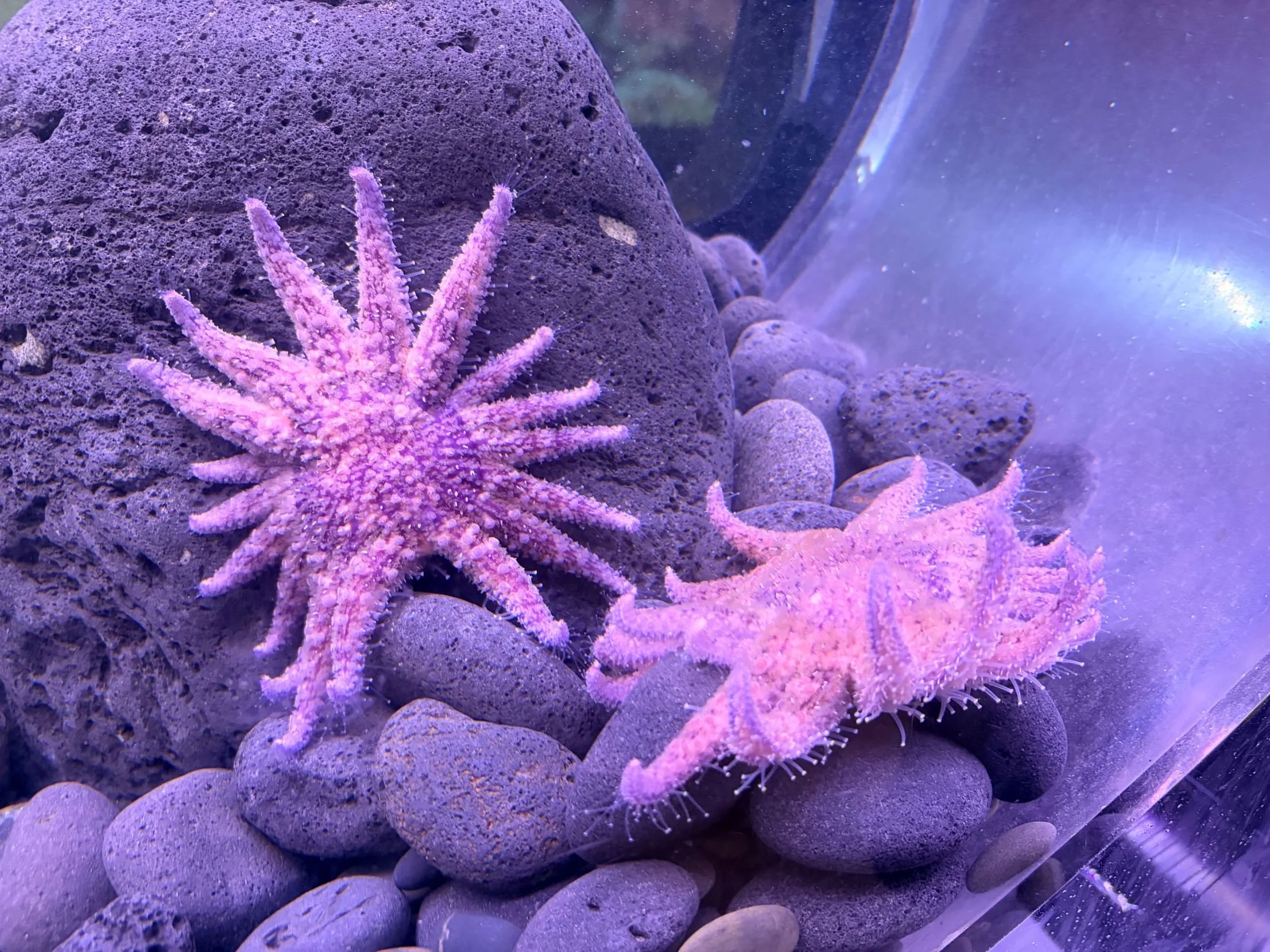
SANTA BARBARA, CA—The Sea Center on Stearns Wharf is the new home of two 18-armed, tube-footed, pale purple urchin eaters. Sunflower Stars (or Pycnopodia helianthoides as they are known to scientists) are fuzzy-looking predators that evolved to play a key role in maintaining healthy kelp forest ecosystems, but have been largely absent from the wild in California since the mid-2010s.
The outbreak of sea star wasting disease in 2013–2014 devastated Sunflower Stars. It was one of the largest marine disease events on record, affecting both wild animals and those in aquariums with exposure to unsterilized seawater. Sea Center Director Rich Smalldon remembers that crushing period: “We had Sunflower Stars here during the disease outbreak, and they basically self-destructed. I came in one day and there were detached arms everywhere. It was shocking and without warning.” The disease—which also affected many other sea star species—can progress rapidly, as stars fragment and turn to goo in just a few days. Recent research suggests it is caused by a strain of bacteria that remains present along the West Coast.
Wild Sunflower Stars ate urchins, helping to regulate the population of kelp grazers. Their presence affected the urchins’ behavior, too, creating what marine ecologist Sarah Gravem, Ph.D., memorably dubbed “a landscape of fear” for the urchin prey. Without stars, urchins moved and ate unchecked. “When they stopped smelling Sunflower Stars nearby, urchins spent less time hiding and more time eating,” explains Sunflower Star Laboratory Executive Director Reuven Bank. “They switched from passively grazing on drift kelp to actively chomping through stipes and holdfasts, razing vast swathes of kelp forests” (kelp’s version of stems and roots).
Since Sunflower Star populations have collapsed, many of California’s kelp forests have become degraded. In the absence of Pycnopodia, kelp-grazing urchins—particularly Purple Urchins—have thrown these biologically, culturally, and economically significant ecosystems out of balance. According to the latest data from kelpwatch.org, 95% of Northern California’s kelp forests have disappeared in the last 10 years, in large part due to urchin overgrazing.
Sunflower Star Laboratory (SSL) is a nonprofit that raises the stars and works with many partners to restore them where they can rehabilitate kelp forests. SSL brought two stars to the Sea Center on June 15, siblings that are part of the Cupid Cohort. This group of animals was raised from eggs collaboratively spawned and fertilized at Birch Aquarium on February 14, 2024. Although SSL is headquartered in Moss Landing, it coordinates with other institutions and researchers across North America, including through groups such as the Pacific Coast Ocean Restoration initiative and Association of Zoos and Aquariums’ Saving Animals from Extinction Sunflower Sea Star Program.
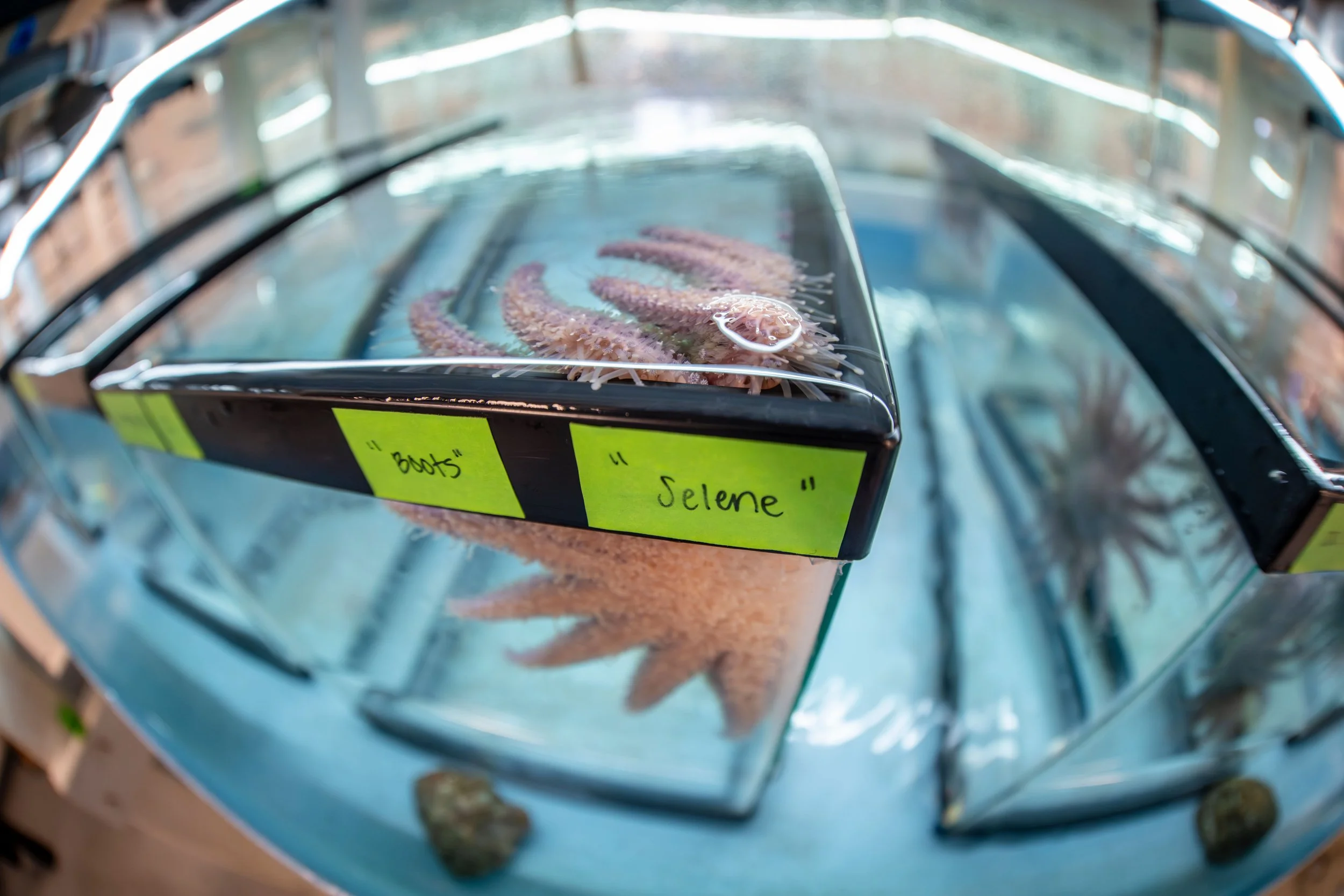
Juvenile sunflower stars growing at SSL by Pat Webster
The joint effort to rear endangered species in human care has parallels with the White Abalone Restoration Consortium. The Sea Center has been a member of that group since 2006, and hopes to play a similar role in educating the public about the effort to restore Sunflower Stars in the wild. Sunflower Stars are listed as critically endangered by the International Union for Conservation of Nature, but are not currently recognized as endangered by the federal government. The White Abalone became the first marine invertebrate to be protected by the Endangered Species Act when it was listed as endangered in 2001.
“The success of the White Abalone Recovery Project serves as an example of the power of collaborative conservation in action, and has informed our approach to Sunflower Star recovery,” says Bank. “Sunflower Star Laboratory serves as a keystone institution for the restoration of this keystone predator alongside dozens of partners, co-leading coordination, research, aquaculture, and outplanting efforts to supercharge the return of Sunflower Stars to the wild and give our dwindling kelp forests a fighting chance.”
SSL has grown hundreds of sea stars at their conservation facility as they scale to meet future restoration needs, while also spearheading the first ever temporary outplantings of Sunflower Stars back into California waters. The Sunflower Stars on display at the Sea Center participated in these inaugural outplanting trials in Monterey, before returning from “camp ocean” to SSL, and now serve as Southern California ambassadors for their species. Sunflower Stars are regularly demonstrating how helpful they could be in kelp forest restoration. Titan—the largest star at SSL at over a foot long—once ate 44 juvenile urchins in a single day!

Vince Christian and Andrew Kim of Sunflower Star Laboratory place a juvenile sunflower star into a pod in Monterey copyright Sage Ono
About the Santa Barbara Museum of Natural History Sea Center
The Sea Center hosts marine science exhibits, events, and educational programs. Thanks to a unique location on Stearns Wharf, this interactive regional aquarium offers close encounters with the biodiversity of the Santa Barbara Channel. The Sea Center is a private nonprofit supported in part by philanthropy, membership, and visitors. Members visit free. For more information or to make a donation, visit sbnature.org/SeaCenter.
About Sunflower Star Laboratory
Sunflower Star Laboratory is a community-based nonprofit that leads research and conservation to recover the Sunflower Star, building kelp forest resilience with our communities. Our organization is actively growing the critically-endangered Sunflower Star and other species in our conservation aquaculture facility in Moss Landing, CA, while conducting novel research and coordinating Sunflower Star recovery efforts across North America. Sunflower Star recovery is an integral part of restoring California’s vanishing kelp forests, and Sunflower Star Laboratory’s experienced, interdisciplinary team leads groundbreaking work to make this imperative a reality. Head to sunflowerstarlab.org and @sunflowerstarlab for more information.